Story
The story of St. Peter's Basilica
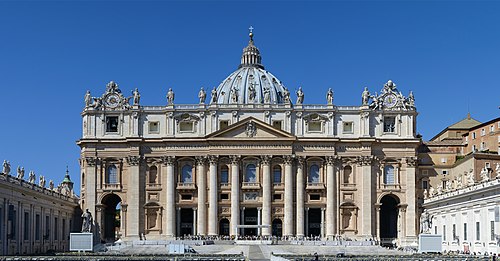
Below the high altar of this church, Catholic tradition places the tomb of Saint Peter himself. Construction began on 18 April 1506 and was completed on 18 November 1626. It replaced Old St. Peter's, built in the fourth century by Emperor Constantine, and was shaped mainly by Bramante, Michelangelo and Carlo Maderno, with the piazza and fittings by Gian Lorenzo Bernini.
It is the largest church in the world by interior measure. Cross St. Peter's Square, first oval then trapezoidal, and climb the steps past two 5.55-metre statues of Saints Peter and Paul.
Around the dome, look for the colossal statues of Longinus with his spear, Helena with the True Cross, Veronica with her veil, and Andrew. Surprisingly, it is not a cathedral, since it is not the seat of a bishop.
This story is compiled from Wikipedia and other open sources; dates and numbers are checked against the source. The text is shared under the CC BY-SA 4.0 licence. Source ↗
Hear this story on the spot, in a natural voice
On Sightlore, the story of St. Peter's Basilica is narrated in a natural voice in 5 languages. When you arrive, say "I'm here" and get your passport stamp.
56 more stories from Rome in the app
More highlights in Rome
- ColosseumRead its story →
- Roman ForumThe Roman Forum, also known by its Latin name Forum Romanum, is a rectangular forum (plaza) surrounded by the ruins of several important ancient government buildings at the centre of the city of Rome.
- Four Rivers FountainFontana dei Quattro Fiumi (Fountain of the Four Rivers) is a fountain in the Piazza Navona in Rome, Italy.
- Trevi FountainThe Trevi Fountain is an 18th-century fountain in the Trevi district in Rome, Italy, designed by Italian architect Nicola Salvi and completed by Giuseppe Pannini in 1762. Standing 26.3 metres (86 ft) high and 49.15 metres (161.3 ft) wide, it is the largest Baroque fountain in…
- Capitoline MuseumsThe Capitoline Museums are a group of art and archaeological museums located on the Capitoline Hill in Rome, Italy, and constitute the main civic museum complex of the city.
- Imperial foraThe Imperial Fora (Fori Imperiali in Italian) are a series of monumental fora (public squares), constructed in Rome over a period of one and a half centuries, between 46 BC and 113 AD.