Croatia
Things to do in Pula & Istria
25 places13 stories2 routes
Sightlore has 25 places to explore in Pula & Istria, and 13 of them come with a 60-second story in 5 languages. Point your camera at a landmark to learn its name and story, and earn points and badges at the places you actually visit.
Pula & Istria's must-sees
The city's most important places. In the app you see how many you've visited and earn a badge when you've seen them all.
- 1

Arch of the Sergii
Arch of the Sergii is an Ancient Roman triumphal arch located in Pula, Croatia.
- 2

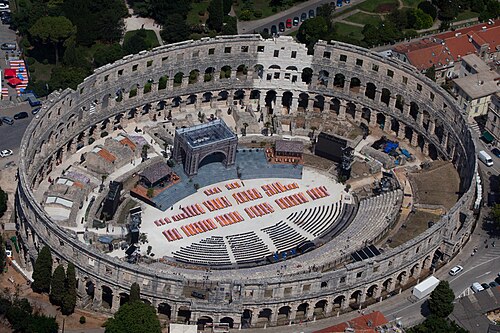
Pula Arena
The Amphitheatre in Pula, better known as the Pula Arena, is a Roman amphitheatre located in Pula, Istria, Croatia.
- 3

Porta Gemina
The Dvojna vrata (Porta Gemina) is a Roman city gate located in Pula, Croatia. It was built during the late 2nd century. Porta Gemina is a double arched gate.
- 4

Euphrasian Basilica
The Euphrasian Basilica or the Cathedral Basilica of the Assumption of Mary is a Roman Catholic basilica in the Istrian town of Poreč, Croatia.
Read its story → - 5

Pula Cathedral
The Pula Cathedral or fully the Cathedral of the Assumption of the Blessed Virgin Mary is a co-cathedral in Pula, Croatia.
- 6

Historical and Maritime Museum of Istria
History and maritime museum set in the Venetian fortress on Pula's highest hill.
- 7

Temple of Augustus
The Temple of Augustus is a well-preserved Roman temple in the city of Pula, Croatia (known in Roman times as Pietas Iulia).
- 8

Motovun
Motovun is a village and a municipality in central Istria, west Croatia. In ancient times, both Celts and Illyrians built their fortresses at the location of present-day Motovun.
- 9

St. Euphemia's Basilica
The Church of St. Euphemia, often known as the Basilica of St. Euphemia (although it is not formally a basilica minor) and by locals as the Church of St.
- 10

Brijuni National Park
National park of fourteen islands off Pula, known for Roman villas, a safari park and Tito's summer residence.
Discovery routes in Pula & Istria
Visit the stops in any order and tap "Check in" at each one; finish the route to earn points and its own badge.
Pula: The Arena and the Roman Town
The Arena, one of the best-preserved amphitheatres in the world, the Venetian fortress on the hill, the Twin Gates, the Archaeological Museum, the Arch of the Sergii, the cathedral and the Temple of Augustus.
Istria: From Brijuni to Motovun
The Brijuni islands, St Euphemia above Rovinj and the Batana museum, the mosaic-filled Euphrasian Basilica in Poreč and the hill towns of Motovun and Grožnjan.
Places to visit
Historic sites
Pula Arena
The Amphitheatre in Pula, better known as the Pula Arena, is a Roman amphitheatre located in Pula, Istria, Croatia.
Porta Gemina
The Dvojna vrata (Porta Gemina) is a Roman city gate located in Pula, Croatia. It was built during the late 2nd century. Porta Gemina is a double arched gate.
Temple of Augustus
The Temple of Augustus is a well-preserved Roman temple in the city of Pula, Croatia (known in Roman times as Pietas Iulia).
Motovun
Motovun is a village and a municipality in central Istria, west Croatia. In ancient times, both Celts and Illyrians built their fortresses at the location of present-day Motovun.

Grožnjan
Grožnjan is a settlement and a municipality in Croatia. It is part of Istria County, which takes up most of the Istrian peninsula. Around 36% of the municipality's population is Italian.

Fort Bourguignon
Fort Bourguignon (Fort Monsival) is one of many fortresses in Pula, Croatia that were built by the Austrian Empire in the second half of the 19th century.

Fort Brioni Minor
Armoured coastal fort built by Austria-Hungary at the end of the 19th century on the island of Mali Brijun.

Istrian National Theater
The Istrian National Theater is a city theater and cultural institution in Pula, established by a decision of the National Committee of the City of Pula on March 19, 1948. The INK is housed in a multi-purpose building, whose former name was Politeama Ciscutti.

Fort Monvidal
Land fort built by Austria in the 19th century on Monvidal hill in Pula.

Naval Cemetery, Pula
Cemetery opened in 1862 for the Austrian navy, one of the largest military cemeteries in Europe.

Fort Punta Christo
Fort Punta Christo is an Austro-Hungarian fortification located in the city of Pula, Croatia. Christo was originally built on the Kristo Peninsula in 1833, and was just a Martello tower.

Fort Turtian
Coastal fort built by Austria-Hungary at the end of the 19th century in the village of Šikići near Pula.

Venetian Fortress, Pula
Seventeenth-century Venetian fortress on the hill commanding Pula bay, on the site of a Histrian hillfort, a Roman castrum and a medieval castle.
Museums
Historical and Maritime Museum of Istria
History and maritime museum set in the Venetian fortress on Pula's highest hill.

Archaeological Museum of Istria
Museum founded in 1902, displaying prehistoric, Roman and medieval finds from Istria.

Ecomuseum Batana
Croatia's first ecomuseum, opened in 2004 and devoted to the batana, Rovinj's traditional flat-bottomed fishing boat.
Places of worship
Pula Cathedral
The Pula Cathedral or fully the Cathedral of the Assumption of the Blessed Virgin Mary is a co-cathedral in Pula, Croatia.
St. Euphemia's Basilica
The Church of St. Euphemia, often known as the Basilica of St. Euphemia (although it is not formally a basilica minor) and by locals as the Church of St.
Euphrasian Basilica
The Euphrasian Basilica or the Cathedral Basilica of the Assumption of Mary is a Roman Catholic basilica in the Istrian town of Poreč, Croatia.

Franciscan Monastery in Pula
The Monastery and Church of St. Francis in Pula, Croatia, are located on the western slope of the Pula hill, halfway between the Forum and the medieval fortress at the top, on the site where the early Christian complex of St. John the Baptist. was previously situated.

Chapel of St. Mary Formosa
The Basilica of Santa Maria del Canneto, or Santa Maria Formosa, was a sixth-century Byzantine church. It was erected in Pola (modern-day Pula, Croatia) under the patronage of Maximianus, bishop of Ravenna.

Naval Church, Pula
Church built for the Austrian navy on St Polycarp hill at the end of the 19th century, today Our Lady of the Sea.

Sveta Srca Gallery, Pula
Exhibition space of the Archaeological Museum in a deconsecrated church, opened in 2011.
Monuments
Arch of the Sergii
Arch of the Sergii is an Ancient Roman triumphal arch located in Pula, Croatia.
Nature
Brijuni National Park
National park of fourteen islands off Pula, known for Roman villas, a safari park and Tito's summer residence.
Explore Pula & Istria with your camera
Hear the stories on the spot, complete routes, collect badges. Sightlore is coming soon to the App Store.