Spain
Things to do in Gran Canaria
32 places24 stories5 routes
Sightlore has 32 places to explore in Gran Canaria, and 24 of them come with a 60-second story in 5 languages. Point your camera at a landmark to learn its name and story, and earn points and badges at the places you actually visit.
Gran Canaria's must-sees
The city's most important places. In the app you see how many you've visited and earn a badge when you've seen them all.
- 1

Risco Caido
Risco Caído is a land-form and archaeological site on the island of Gran Canaria, Spain. The site contains prehistoric cave dwellings, temples, and granaries attributed to the pre-Hispanic culture of the Canary Islands.
- 2

Playa de Las Canteras
The Playa de Las Canteras is the main urban beach of the city of Las Palmas de Gran Canaria, on the island of Gran Canaria in the Canary Islands. It is considered one of the most prominent beaches in the archipelago.
- 3

Bandama Caldera
The Bandama Natural Monument is part of the Tafira Protected Landscape on the island of Gran Canaria in the Canary Islands, Spain. It is considered a point of geological interest, because of the Caldera de Bandama.
- 4

Maspalomas Lighthouse
The Maspalomas Lighthouse is an active 19th century lighthouse at the southern end of the Spanish island of Gran Canaria, in the Canary archipelago.
- 5

House museum of Christopher Columbus
The Casa de Colón is a listed historic house in Las Palmas de Gran Canaria; today it holds a museum whose main theme is Columbus and his voyages.
- 6

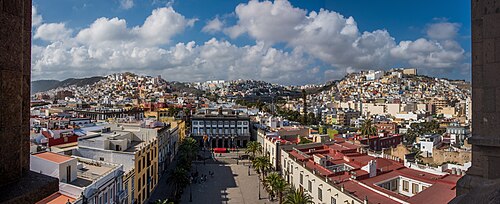
Vegueta
Vegueta is the founding district of Las Palmas de Gran Canaria, declared a national historic-artistic site on 5 April 1973.
- 7

Teatro Pérez Galdós
The Teatro Pérez Galdós is the most important theatre of Las Palmas de Gran Canaria, home of the city's opera festival, standing in the Triana district near the sea.
- 8

Church of San Juan Bautista
The Church of San Juan Bautista or Arucas Church, is a Catholic church located in the old town of Arucas, in Gran Canaria, Canary Islands, Spain. Construction began on 19 March 1909, and took over 68 years.
- 9

Cathedral Basilica of St. Ann
The Cathedral of Santa Ana (Holy Cathedral-Basilica of Canary or Cathedral of Las Palmas de Gran Canaria) is a Roman Catholic church located in Las Palmas, Canary Islands. The cathedral is the see of the Roman Catholic Diocese of Canarias.
Read its story → - 10

Caves of Valeron
Valerón's "monastery" (in Spanish cenobio de Valerón) is an archaeological site on the Spanish island of Grand Canary, in the municipality of Santa Maria de Guia, on Valerón's cliff.
Discovery routes in Gran Canaria
Visit the stops in any order and tap "Check in" at each one; finish the route to earn points and its own badge.
Gran Canaria: Vegueta and the Traces of Columbus
In Vegueta, the founding district of Las Palmas: from Santa Ana Cathedral to the House of Columbus, the Canarian Museum, CAAM and the Teatro Pérez Galdós in Triana.
Gran Canaria: Las Canteras and La Isleta
From the Elder Science Museum to the Castillo de la Luz, the Poema del Mar aquarium and along Las Canteras beach to El Confital.
Gran Canaria: Churches and Caves of the North
From the great church of Arucas to the rock granary of Valerón, the Painted Cave at Gáldar and the Basilica del Pino at Teror.
Gran Canaria: Craters and Sacred Mountains
From the Bandama crater to the island's summit, Pico de las Nieves, to Roque Nublo and the UNESCO-listed Risco Caído.
Gran Canaria: The South Coast
From the Guayadeque ravine to the Maspalomas dunes and lighthouse, Palmitos Park and Puerto de Mogán, the 'Venice of the Canaries'.
Places to visit
Historic sites
Vegueta
Vegueta is the founding district of Las Palmas de Gran Canaria, declared a national historic-artistic site on 5 April 1973.
Teatro Pérez Galdós
The Teatro Pérez Galdós is the most important theatre of Las Palmas de Gran Canaria, home of the city's opera festival, standing in the Triana district near the sea.
Risco Caido
Risco Caído is a land-form and archaeological site on the island of Gran Canaria, Spain. The site contains prehistoric cave dwellings, temples, and granaries attributed to the pre-Hispanic culture of the Canary Islands.
Maspalomas Lighthouse
The Maspalomas Lighthouse is an active 19th century lighthouse at the southern end of the Spanish island of Gran Canaria, in the Canary archipelago.

Puerto de Mogán
Puerto de Mogán is a picturesque fishing village and popular marina in the municipality of Mogán, set at the mouth of a steep-sided valley on the south-west coast of the island of Gran Canaria.

Faro de La Isleta
La Isleta Lighthouse is an active 19th century lighthouse on the Spanish island of Gran Canaria in the Canary islands.

Castle of San Francisco
The Castillo de San Francisco, also called Castillo del Rey or del Paso Angosto, is a 17th-century defensive fortress on the hill of the same name in Las Palmas de Gran Canaria; construction began in 1601.
Museums
House museum of Christopher Columbus
The Casa de Colón is a listed historic house in Las Palmas de Gran Canaria; today it holds a museum whose main theme is Columbus and his voyages.

Canarian Museum
El Museo Canario is an archeological museum in Las Palmas, the capital city of Gran Canaria in the Canary Islands. It is dedicated to the pre-colonial history of the Canary Islands.

Centro Atlántico de Arte Moderno
The Atlantic Center for Modern Art (CAAM) is a contemporary art museum in the Canary Islands, Spain. It is in Vegueta in Las Palmas, the capital city of Gran Canaria.

Elder Museum of Science and Technology
The Elder Museum of Science and Technology is a museum in Las Palmas de Gran Canaria, the capital city of Gran Canaria, in the Canary Islands.

Castillo de la Luz
The Castillo de la Luz is a fortress in the north of Las Palmas de Gran Canaria that once stood on the sea; the square, thick-walled building dates from 1541 and reopened in 2014 as a sea museum and art venue after long restoration.

Painted Cave, Galdar
The Painted cave is an archaeological museum and park in the town of Galdar, located the northwest of Grand Canary in the Canary Islands, Spain.
Places of worship
Cathedral Basilica of St. Ann
The Cathedral of Santa Ana (Holy Cathedral-Basilica of Canary or Cathedral of Las Palmas de Gran Canaria) is a Roman Catholic church located in Las Palmas, Canary Islands. The cathedral is the see of the Roman Catholic Diocese of Canarias.
Church of San Juan Bautista
The Church of San Juan Bautista or Arucas Church, is a Catholic church located in the old town of Arucas, in Gran Canaria, Canary Islands, Spain. Construction began on 19 March 1909, and took over 68 years.

Basílica de Nuestra Señora del Pino
The Basílica de Nuestra Señora del Pino is a Catholic church and parish in Teror, Gran Canaria, Canary Islands, Spain. The present building in neoclassical style was built from 1760 to 1767. It is dedicated to the Virgen del Pino.

Templo Ecuménico El Salvador, Playa del Inglés
The Templo Ecuménico El Salvador is a church in Playa del Inglés, Gran Canaria, shared by several Christian denominations; designed by Manuel de la Peña Suárez, it was built in 1968–1971.
Nature

Poema del Mar Aquarium
The Poema del Mar is an aquarium located in Las Palmas de Gran Canaria, Spain.
Playa de Las Canteras
The Playa de Las Canteras is the main urban beach of the city of Las Palmas de Gran Canaria, on the island of Gran Canaria in the Canary Islands. It is considered one of the most prominent beaches in the archipelago.

El Confital
El Confital is a beach in Las Palmas de Gran Canaria, on the La Isleta peninsula in the north-east of the island.
Caves of Valeron
Valerón's "monastery" (in Spanish cenobio de Valerón) is an archaeological site on the Spanish island of Grand Canary, in the municipality of Santa Maria de Guia, on Valerón's cliff.
Bandama Caldera
The Bandama Natural Monument is part of the Tafira Protected Landscape on the island of Gran Canaria in the Canary Islands, Spain. It is considered a point of geological interest, because of the Caldera de Bandama.

Pico de las Nieves
Pico de las Nieves is the highest peak and a stratovolcano on the island of Gran Canaria, Canary Islands, Spain. Its height is 1,949 metres (6,394 ft) above sea level. On its slopes, Canary Islands Pine was reintroduced in the 1950s.

Roque Nublo
Roque Nublo (Clouded Rock, Rock in the Clouds) is a volcanic rock on the island of Gran Canaria, Canary Islands, Spain. It is 80 m (262 ft) tall, and its top is 1,813 m (5,948 ft) above sea level.

Barranco de Guayadeque
The Guayadeque ravine, in Spanish Barranco de Guayadeque, is a ravine-type valley located on the Spanish municipalities of Ingenio and Agüimes, in the province of Las Palmas on Grand Canary island.
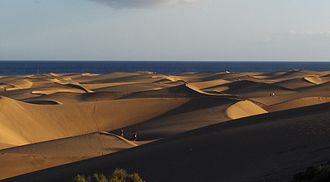
Maspalomas Dunes
The Maspalomas Dunes are sand dunes located on the south coast of the island of Gran Canaria, Province of Las Palmas, in the Canary Islands.

Palmitos Park
Palmitos Park is a 20-hectare (49-acre) botanical garden, aviary and zoo on the island of Gran Canaria, Canary Islands, Spain.

Jardín Botánico Canario Viera y Clavijo
Jardín Botánico Canario Viera y Clavijo is the full name of the botanical garden on Gran Canaria, one of the Canary Islands.

Cuatro Puertas
The Four Doors (in Spanish Cuatro Puertas) site, also known as Montaña Bermeja, 'Vermillion Mountain', is a complex of caves in the south of the municipality of Telde, Gran Canaria.

Alcavaneras
Las Alcaravaneras is one of the urban beaches of Las Palmas de Gran Canaria, the second most visited by locals after Las Canteras.

Meloneras
Meloneras is a tourist town on the south coast of the island of Gran Canaria, Canary Islands, part of the town of Maspalomas in the municipality of San Bartolomé de Tirajana.

Pozo Izquierdo
Pozo Izquierdo is a place and stretch of coast in Santa Lucía de Tirajana on the south-east coast of Gran Canaria, famous for ideal windsurfing conditions and a regular venue of the world championships.
Explore Gran Canaria with your camera
Hear the stories on the spot, complete routes, collect badges. Sightlore is coming soon to the App Store.