Story
The story of pont du Gard
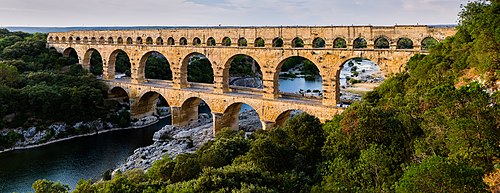
Look closely at the stones and you may spot the builders' marks: assembly signs showing where each block belonged, such as one meaning left face two, and carved phalluses meant to ward off evil. This three-tiered bridge carried a Roman aqueduct over the Gardon, bringing water more than 50 kilometres from the Fontaine d'Eure near Uzès to Nemausus, today's Nîmes.
Over its whole course the aqueduct drops only 12.6 metres, an average slope of 24.8 centimetres per kilometre, and the water took a full day to arrive. Probably built between the years 40 and 50, the bridge rises 48.77 metres above the river, the highest known aqueduct bridge in the Roman world.
It was built almost entirely without mortar, and some of its stones weigh six tonnes. In the Middle Ages the bridge served as a road bridge, and since December 1985 it has been a UNESCO World Heritage Site.
This story is compiled from Wikipedia and other open sources; dates and numbers are checked against the source. The text is shared under the CC BY-SA 4.0 licence. Source ↗
Hear this story on the spot, in a natural voice
On Sightlore, the story of pont du Gard is narrated in a natural voice in 5 languages. When you arrive, say "I'm here" and get your passport stamp.
19 more stories from Avignon in the app
More highlights in Avignon
- Musée du Petit PalaisThe Musée du Petit Palais is a museum and art gallery in Avignon, southern France.
- Avignon CathedralAvignon Cathedral is a Roman Catholic church located next to the Palais des Papes in Avignon, France. The cathedral is the seat of the Archbishop of Avignon.
- Pont Saint-BénézetThe Pont Saint-Bénézet, also known as the Pont d'Avignon, was a medieval bridge across the Rhône in the town of Avignon, in southern France. Only four arches survive.
- Palais des PapesThe Palais des Papes in Avignon, Southern France, is one of the largest and most important medieval Gothic buildings in Europe. Once a fortress and palace, the papal residence was a seat of Western Christianity during the 14th century.
- arc antique d'Orange
- Jardin des domsThree-hectare 19th-century public garden on the rocky outcrop above the Rhône next to the Palais des Papes in Avignon.